The Law Society’s Conveyancing Quality Scheme (CQS) 2026 training update is available now. 

Stay accredited with a trusted training supplier to over 1900 firms. Book now.

Family Law Microcredential (Monday 2 March 2026) Web refresh

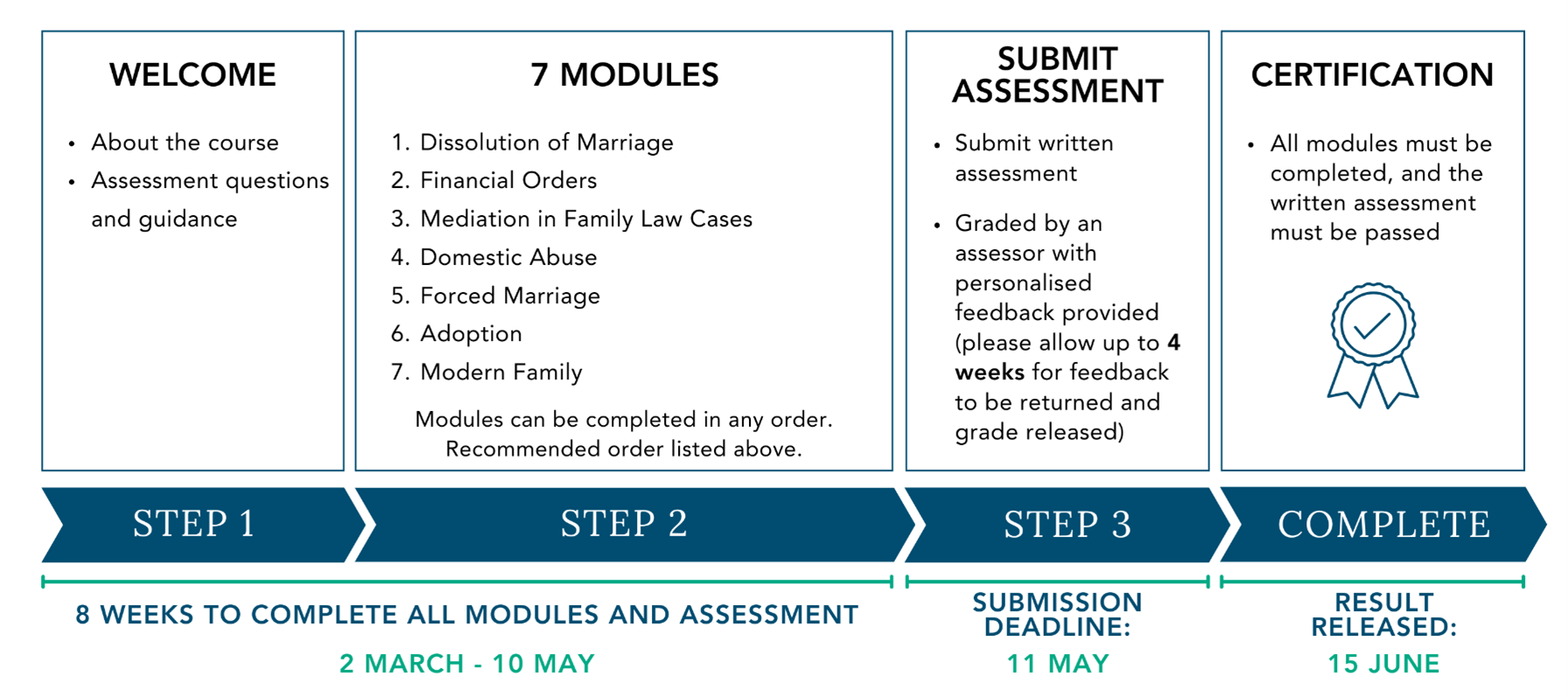
Course run: Monday 2 March to Sunday 10 May 2026

Assessment due: Monday 11 May 2026, 5pm

Results released: Monday 15 June 2026

Places are limited – enrol now to avoid disappointment.

Family law holds a unique place in the legal landscape as it requires practitioners to advise clients about deeply private issues within a robust legislative framework.

Our Family Law microcredential will give you a thorough grounding in key family issues like dissolution of marriage, financial orders and mediation, as well as insight into topics that you will inevitably encounter in your practice, such as domestic abuse. The microcredential also covers specialist practice areas like forced marriage, adoption, and issues associated with assisted conception and surrogacy.

After you have successfully completed the course and submitted your assessment, you will receive a grade and feedback. You will also be awarded a digital credential as evidence of your achievement.

Whether you are new to family law or want to update your knowledge, this microcredential is for you – enrol now! 

Please note that due to the nature of the programme, the course must be completed within the dates specified. It cannot be mixed and matched with other offerings.

For bulk purchase discounts on this training, please contact us.
What this will cover

This course will cover:

Dissolution of Marriage (by Polly Morgan)

This module looks at the legal processes to be followed in pursuing dissolution of a marriage or civil partnership, providing practical guidance on how to advise clients effectively in this area.

Financial Orders (by Polly Morgan)

This module looks at the various forms of financial provision that can be made on divorce, looking at how to identify matrimonial assets and orders for child maintenance.

Mediation in Family Law Cases (by Sarah-Jane Riddell)

This module sets out the main types of mediation, providing practical insights into how to determine the suitability of mediation for an individual client and the information about mediation that should be provided to clients by their lawyers.

Domestic Abuse (by Sarah Jane Lenihan)

This module provides insights into the legal definition of domestic abuse under the Domestic Abuse Act 2021, explaining the signs that domestic abuse is present and the steps that should be taken to address it.

Forced Marriage (by Alison Leivesley)

This module examines the area of forced marriage, explaining the legislative protection available and the processes to be followed in making an application for a forced marriage protection order.

Adoption (by Lucy Birch)

This module sets out the procedure to be followed in non-agency adoptions, looking at the eligibility requirements and issues of parental consent and post-adoption contact.

Modern Families (by Deborah Baxter)

This module explains the term modern family, looking at the legal frameworks associated with modern families and the particular considerations associated with assisted conception and surrogacy.

Learning outcomes

By the end of this course, you will be able to:

  • understand the legal basis for and the procedures to be followed in seeking the dissolution of a marriage or civil partnership
  • identify the various financial orders that are available in the event of divorce, as well as the risks and benefits associated with different courses of action
  • understand the different types of mediation and advise clients appropriately on which forms of mediation are suitable in their situation
  • explain the legal definition of domestic abuse and advise clients appropriately on the most appropriate order(s) for their circumstances
  • understand how to recognise signs of forced marriage and the legal mechanisms and additional resources available to support those affected
  • explain the legal procedure to be followed in making an adoption order on a non-agency basis, including issues of parental consent and post-adoption contact
  • understand the meaning of the term ‘modern family’ and the associated legal frameworks, including the legal considerations related to assisted conception and surrogacy
How you will learn

Course format

This course is self-paced and provides best-practice guidance by incorporating practical activities, self-directed tools, and interactive scenarios designed to boost your skills and help you remain competitive. It consists of an interactive presentation for each module with knowledge checks, reflection points, and scenarios throughout the course.

Knowledge checks feature throughout the course as an opportunity to test and apply your understanding. Please note, they do not form part of the assessment.

Assessment

There will be an open book assessment comprised of five essay-style questions. Your submission should total no more than 1,350 words.

You will receive the questions at the beginning of the course to allow for reflective learning. The assessment is designed to assess your knowledge and understanding of the content and learning outcomes covered within the course.

On completion of the modules, the assessment will unlock and you will be able to upload your submission. Only one submission attempt is allowed.

Assessment feedback

After you have successfully completed the course and submitted your assessment, you will receive a grade and personalised feedback. The personalised feedback will offer specific comments on your submission, highlighting strengths and areas for improvement. It will help you to understand your progress and identify areas that might need further development.

To pass the assessment, you must achieve a mark of 50%.

On passing your assessment, you’ll be awarded a digital credential as evidence of your achievement that can accompany you wherever your career takes you – a quality mark you can add to your website or promote on social media to show clients that you’re competent and compliant in core legal, professional and personal skills.

Assessment dates

The assessment deadline is Monday 11 May 2026 at 5pm. You will receive final grades and personalised feedback on Monday 15 June 2026.

Online accessibility
Our modules conform to Web Content Accessibility Guidelines 2.1. However, some members may require an alternative version for accessibility purposes. This is available upon request via our contact us form.

Also, if you need alternative arrangements for submitting your assessment, please get in touch.

Meet the experts

This microcredential has been developed by six industry experts:

Free (ex VAT)

Or

Format
Another test
Level
Intermediate
Who is it for?
Small firms lawyers
Course length
8 hours
Assessment type
Scenario-based questions
SRA Competence
A1
A2

The experts

Amy Bell
Amy Bell

Expert

View expert bio

Laurence Howland

Expert
Facilitator

View expert bio

Hugo Lodge

Expert
Facilitator

View expert bio

Lesley King

Expert

View expert bio

Nicola Burgess

Expert

View expert bio

Julian Bild

Expert

View expert bio

Stuart Turnock

Expert

View expert bio

Related Products

You may also be interested in these Law Society training courses.